Petty Cash Book Excel - Free Template
Track petty cash receipts, payments, VAT, running balance and reconciliation in one UK book for small firms and clubs.
This petty cash book Excel template is a simple UK cash control sheet for recording small cash receipts and payments, checking VAT, and keeping a running balance. It includes a transaction log, a Summary sheet and an Instructions sheet.
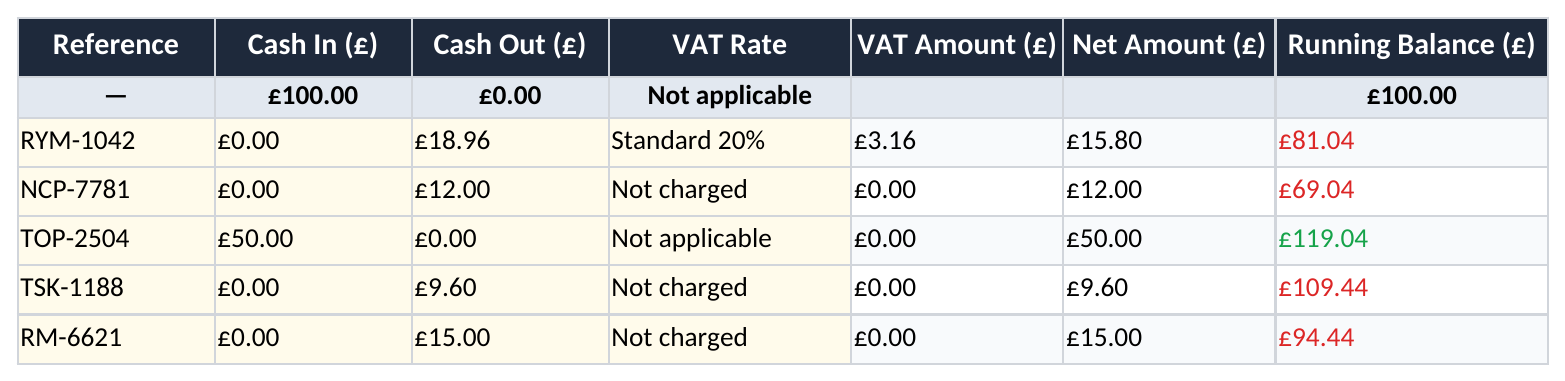
Use it when you need to track the cash tin in a shop, workshop, office or club without moving to full accounting software. The Petty Cash Book sheet captures the date, voucher number, supplier or payee, category, VAT rate, VAT amount, net amount, running balance, reconciliation status and notes.
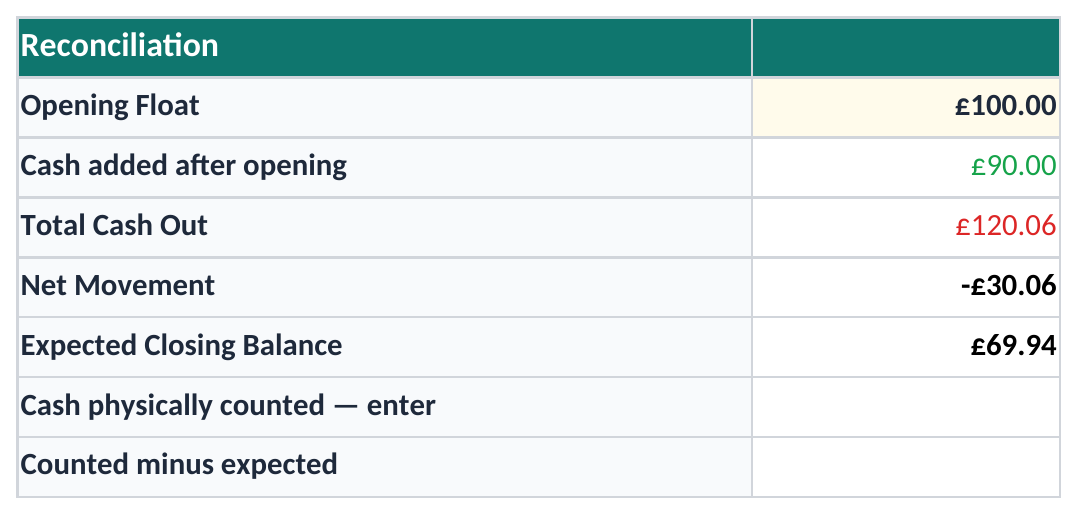
Image 1 shows the transaction sheet with colour-coded input areas and a wide notes column. Image 2 shows the summary area, and image 3 gives you the setup notes so you can keep entries consistent from day one.
The key benefits of this Excel template
- Records every petty cash movement in one place, including cash in, cash out and the running balance.
- Helps you track VAT correctly by showing a separate VAT rate and VAT amount column.
- Reduces cash-counting errors by keeping a live balance after each entry.
- Supports reconciliation with a clear Reconciled? field for each voucher.
- Gives you a tidy audit trail with date, voucher number, supplier or payee and reference fields.
- Works well for small teams, clubs and offices that still use physical cash for minor spending.
- Saves time at month end because the entries are already grouped for review and summary.
Step-by-step guide
- Enter each petty cash movement on the Petty Cash Book sheet. Start with the date, voucher number and description so the record is clear if someone checks it later.
- Choose the correct category, department and supplier or payee. That makes it easier to analyse spending and spot repeat items such as parking, postage or cleaning supplies.
- Enter the cash in or cash out amount, then fill in the VAT rate and VAT amount if the item includes VAT. Use the net amount field so the book ties back to your bookkeeping.
- Check the running balance after each line. If the balance looks wrong after a few entries, the mistake is usually in the last cash movement or the VAT split.
- Mark the item as reconciled once the voucher, receipt or float check has been matched. That gives you a simple control for month-end or year-end review.
- Use the Summary sheet to review totals and the Instructions sheet when setting up a new user or handing the file to a colleague.
Features included
Who uses a petty cash book in UK businesses
This template suits the people who still handle small amounts of physical cash: a sole trader with a workshop float, an office manager at a trades firm, a bookkeeper in a small Ltd company, or a club treasurer balancing receipts after a match day. If you have £20, £50 or £100 moving in and out through the week, you need a clear record before the notes disappear.
Where it fits into the month
You will usually update it when cash is topped up, when a receipt lands on your desk, or when you count the tin at week-end. A café with 6 staff might spend £18 on milk, £24 on cleaning items and £9 on parking in one day; without a petty cash book, those small items become guesswork at month end.
What the screenshots show
Image 1 shows a wide transaction table with a fixed header row and a shaded title band. Image 2 gives you a summary view, and image 3 contains the setup notes, so the workbook works as both a working ledger and a handover file.
HMRC record keeping and the VAT treatment of petty cash
HMRC expects you to keep business records that support your figures. For a company, keep records for 6 years; for the self-employed, keep them for 5 years after the 31 January Self Assessment deadline, which means a 2026 return filed online by 31/01/2027 must still be supported until at least 31/01/2032.
VAT on small cash spends
If you are VAT-registered, petty cash items should show the VAT rate and VAT amount separately where VAT is chargeable. The standard rate is 20%, the reduced rate is 5% and the zero rate is 0%; for example, a £12.00 taxi receipt at 20% VAT contains £2.00 VAT and £10.00 net.
Why the columns matter
The template includes separate fields for cash in, cash out, VAT rate, VAT amount and net amount because that is what you need to post figures correctly. If your business is under the VAT registration threshold of £90,000 of taxable turnover, you may not reclaim VAT at all, but you still need the book for internal control and year-end accounts.
That same cash book also feeds a cash flow forecast, since the cash in and cash out columns show how much money is likely to move through the business.
The petty cash errors that waste time and money
The usual failure is not the spending itself, it is the missing paperwork. A £7.80 parking receipt, a £14.95 courier charge and a £26.40 cleaning purchase may look trivial, but if 10 such items go missing each month you can lose £500 a year in unexplained spend before you have even counted the float.
Balance errors and duplicate claims
Another common problem is entering the same voucher twice or posting a cash-out amount without the cash-in top-up that restored the float. If your balance starts at £100 and you record £68 of spend, the remaining cash should be £32; if the sheet says £29.50, you know there is a £2.50 error to find.
Receipts without detail
Receipts with no supplier name, no date or no clear purpose are weak evidence at review time. That matters at year-end accounts because petty cash is often checked against other expense lines, and one unsupported box of screws or stationery run can delay the close if you have to chase the paper trail.
How to make the petty cash book part of your routine
The sheet works best when you update it at the same time every time. For many small businesses that means straight after the cash count on Friday, or as part of the week-end close before payroll or the VAT review.
Simple habits that stick
- Keep the file open near the cash tin so you enter items while the receipt is still in your hand.
- Use the voucher number as soon as you hand out cash, then match the receipt later.
- Review the running balance every week and top up the float before it drops too low.
- Use the Summary sheet at month end to check total spend by category and department.
When spreadsheet control is no longer enough
If you are handling dozens of cash lines a day, multiple branches or several users editing at once, a spreadsheet will start to slow you down. At that point, move to accounting software with user permissions and bank feeds, but for a small float with 20 to 40 entries a month this template is still the quickest practical answer.
Frequently asked questions about this template
It records small cash transactions such as parking, postage, stationery, cleaning supplies and minor refunds. It gives you a running balance so you can see what is left in the float at any point.
Yes. The Petty Cash Book sheet has separate VAT Rate and VAT Amount columns, plus a Net Amount field, so you can split gross spending properly where VAT applies.
Use a unique sequential number such as PC001, PC002 and PC003. That makes it easier to trace each payment back to a receipt and spot missing vouchers.
Keep them for 6 years if you are running a company. If you are self-employed, keep them for 5 years after the 31 January Self Assessment deadline for the tax year they relate to.
Yes. A treasurer can use it to record cash float movements, receipts and reimbursements, especially where small items are paid out in cash after events or matches.
If the cash tin is being used every day, several people are entering transactions or you need automatic links to bank feeds and VAT returns, accounting software will usually be the better fit. For a low-volume float, this template is usually enough.
Excel template by
Chartered Certified Accountant (FCCA)
Eleanor Hartley is a Chartered Certified Accountant (FCCA) with more than 15 years' experience supporting UK small businesses, sole traders and bookkeepers. She has prepared VAT returns, Self Assessment filings and year-end accounts for hundreds of clients, and builds every template here to match how HMRC and UK businesses actually work.
Guide written by
Chartered Bookkeeper (MICB)
Oliver Whitfield is a chartered bookkeeper (MICB) and former practice manager who has spent over a decade helping UK sole traders and limited companies keep clean, HMRC-ready records. He writes the step-by-step guides on UK Sheets, turning VAT, payroll and Self Assessment rules into plain-English instructions anyone can follow.