Freelance Invoice Excel – Free Template (2026)
7
Free download
Track director transactions, running balances and s455 tax in one Excel workbook for UK limited companies and their bookkeepers.


A director’s loan account Excel template records money a director takes from or pays into a company, tracks the running balance and helps identify a potential section 455 Corporation Tax charge. This workbook contains a transaction register, summary dashboard, s455 tax calculator and instructions sheet.
Use it for one director and one company by replacing the sample details and transactions. The register separates money in from money out, while the dashboard and calculator give you a practical year-end review of the account.
A director’s loan account spreadsheet is most useful when the company owner is also handling bookkeeping. A director of a small Ltd may pay a personal bill from the company card on Monday, transfer £2,000 to their personal account on Friday and repay £500 before the month ends. Those entries belong in the company’s DLA records, not in a vague drawings total.
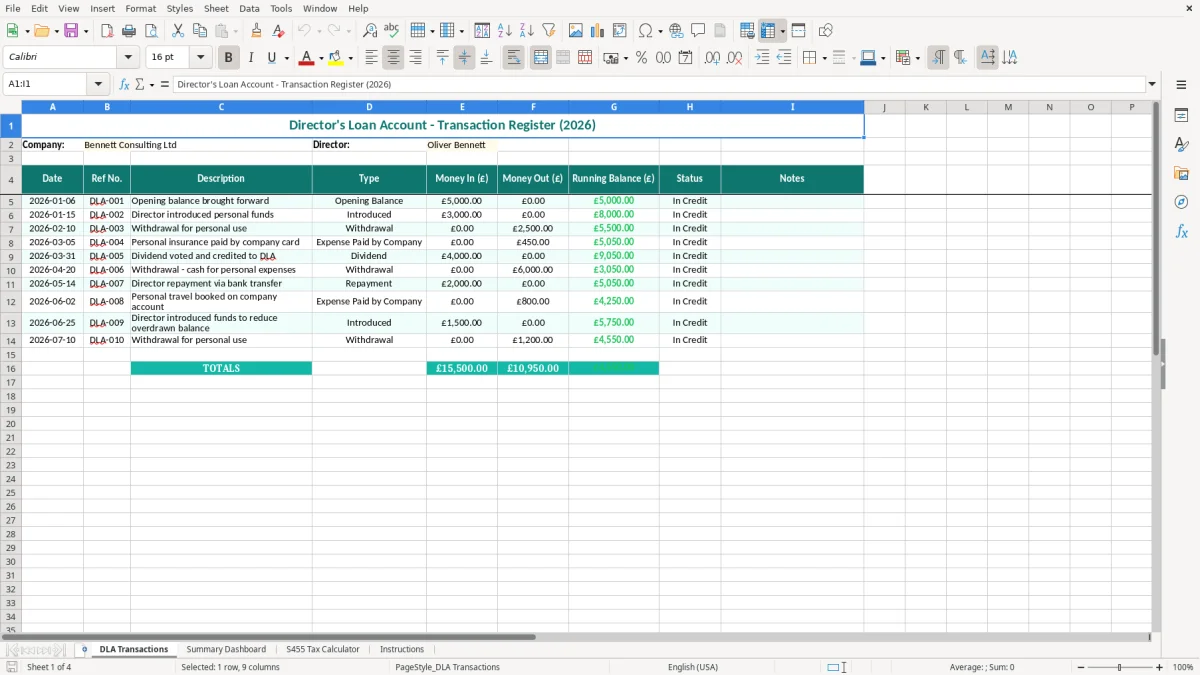
Image 1 shows the DLA Transactions sheet, which is the working register. It has columns for Date, Ref No., Description, Type, Money In (£), Money Out (£), Running Balance (£), Status and Notes. The sample rows include an opening balance, personal funds introduced by the director, a personal withdrawal, an expense paid by the company and a dividend entry.
A bookkeeper at a five-person consultancy can use the register while reconciling the company bank account. If the bank shows £3,000 transferred to the director, the bookkeeper records the date, reference and withdrawal rather than waiting until the year-end accounts reveal an unexplained debit balance.
The same approach works for a tradesperson’s company. A builder who uses a company card for a £450 personal insurance payment has created a director-related transaction even though no cash was withdrawn. Recording the amount under Money Out with a precise description makes the item easier to trace.
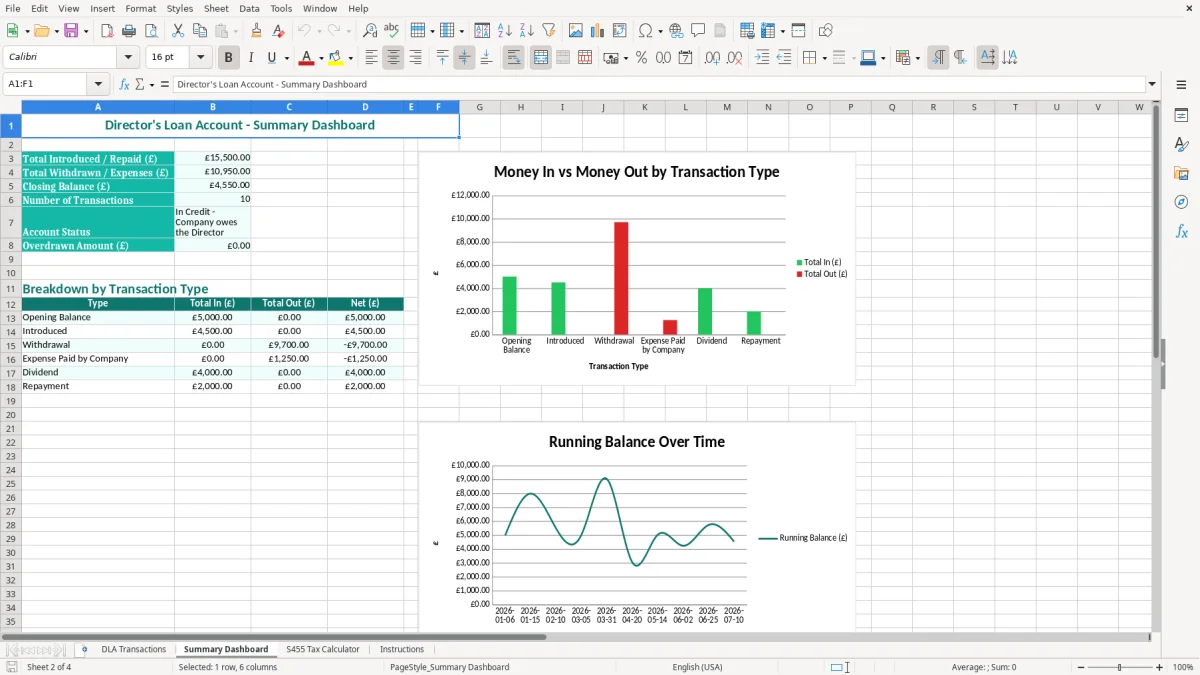
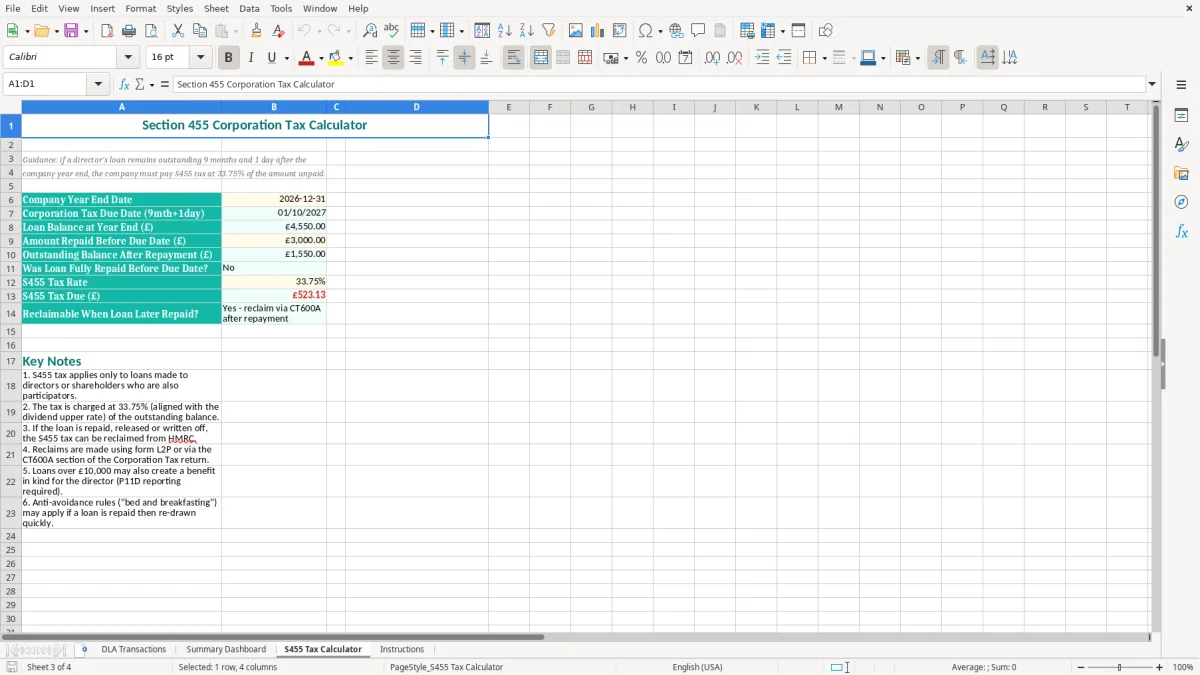
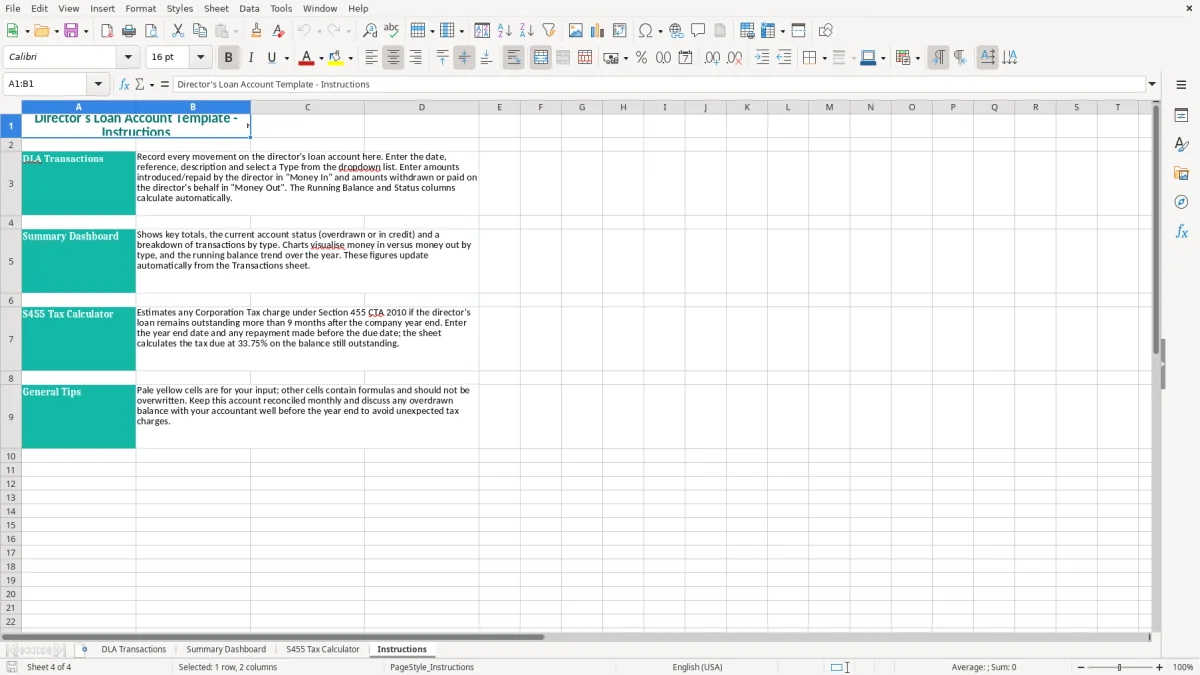
At the company year-end, the owner or accountant can compare the spreadsheet with the nominal ledger and bank statements. Image 2 shows the Summary Dashboard, which gives a quicker visual review of the activity than reading every transaction row. Image 3 is the S455 Tax Calculator, while image 4 is the Instructions sheet.
For a company with 25 transactions across the year, this layout is usually sufficient. For several directors, keep a separate workbook or clearly separated register for each director rather than combining balances and losing ownership of the debt.
Under the Corporation Tax rules, a company must identify loans and advances to a director or other participator accurately. An overdrawn DLA can create a section 455 charge under Corporation Tax Act 2010, section 455, where the loan remains outstanding nine months and one day after the end of the company’s accounting period.
For loans made on or after 6 April 2026, the section 455 rate is 35.75%. The S455 Tax Calculator sheet is designed to help you work through the amount, but you must use the rate and assumptions displayed in the workbook when completing the calculation. A £10,000 relevant overdrawn balance at 35.75% gives a potential charge of £3,575.
Repaying a loan shortly before the nine-month deadline does not always end the analysis. The anti-avoidance rules can apply where a director repays at least £5,000 and then takes a similar loan within 30 days, or where arrangements are used to create a temporary repayment. A £12,000 balance cleared on 20 September and replaced with £11,000 on 5 October needs more than a simple closing-balance check.
The company normally reports the relevant liability on its Corporation Tax return. When the loan is repaid or released, the company may reclaim the section 455 charge, but HMRC does not generally repay it until nine months and one day after the end of the accounting period in which the loan was cleared.
Keep bank statements, expense receipts, dividend vouchers, board minutes and repayment evidence with the register. A dividend is not automatically a repayment: it needs proper authority and must be supported by distributable profits. A personal payment made by the director into the company is normally money introduced, but the bookkeeping entry must still agree with the bank.
Retain company accounting records for at least six years from the end of the relevant financial year. The spreadsheet supports the record, but it does not replace the company’s ledger, statutory accounts or Corporation Tax return.
The most expensive mistakes usually happen when personal and company spending is mixed together for months. I have seen a director withdraw £1,500 every month and label each payment drawings, while the company records showed no DLA. After 12 months, the unrecorded £18,000 balance had to be reconstructed from bank statements and personal explanations.
A common spreadsheet error is treating money paid by the director into the company as money out, or entering a company-paid personal expense as money in. That reverses the balance. If the genuine opening debit is £8,000 and a £2,000 repayment is entered in the wrong column, the sheet may show £10,000 overdrawn instead of £6,000.
Another problem is posting a dividend against the DLA without checking the paperwork. A £6,000 journal can reduce the apparent balance, but it is not a valid dividend merely because the figure fits. If there are insufficient distributable profits, the entry can be challenged and the director may still owe the company.
Duplicate bank imports cause a different failure. A £4,000 transfer entered once from the bank feed and once from the director’s email confirmation doubles the withdrawal. On a £4,000 balance, that error can produce a false £8,000 balance and a potential S455 calculation that is £1,430 too high at 35.75%.
Do not overwrite old rows to make the balance look tidy. Add a correcting transaction with a reference and explanation. This preserves the trail and lets another person follow the correction back to the statement.
Finally, do not rely only on the closing figure. Review the largest withdrawals, unexplained personal expenses and any repayment close to the nine-month-and-one-day deadline. A spreadsheet that balances mathematically can still be wrong if the transaction classification or supporting evidence is wrong.
The same check belongs in your bookkeeping records, where the corrected entries, withdrawals and repayment dates sit beside the supporting evidence for a clean audit trail.
The best way to keep a DLA accurate is to attach it to an existing bookkeeping appointment rather than treating it as a year-end project. Set a fixed date, such as the last working day of each month, and reconcile every director-related bank transaction before the accounts are closed.
For example, a director with six transactions in March can spend ten minutes entering the dates and amounts immediately after the bank reconciliation. Waiting until the March year-end may mean searching 80 bank lines and several months of personal card receipts instead.
Keep the original sample structure and copy the workbook before making major changes. Use the yellow input areas for information you enter, retain DD/MM/YYYY dates and keep amounts as numbers so the dashboard and S455 calculation can work correctly.
Review the Summary Dashboard after each month-end, not just on 31 March or 31 December. If the balance rises above £10,000 and repayments are irregular, flag it for a closer benefit-in-kind and tax review rather than assuming a last-minute dividend will solve it.
Move to bookkeeping software when you have several directors, hundreds of transactions, frequent bank feeds or a need for user permissions and an audit log. Excel remains a sensible control sheet for a small company, but it is not a substitute for a properly reconciled ledger where multiple users can edit entries at the same time.
That shift also means using a proper bank reconciliation sheet to keep the control totals aligned with the ledger as transactions and users start to multiply.
A director’s loan account records money a director takes from or pays into their company, excluding normal salary, dividends properly declared and genuine expense reimbursements. The balance can be in credit, meaning the company owes the director, or overdrawn, meaning the director owes the company.
Section 455 tax can apply to a loan or advance to a director or other participator that remains outstanding nine months and one day after the end of the company’s accounting period. For loans made on or after 6 April 2026, the rate is 35.75%, subject to the rules and assumptions relevant to the transaction.
The workbook has fields for one company and one director on the DLA Transactions sheet. For more than one director, use a separate copy or create a carefully controlled register for each person so that balances and supporting evidence do not become mixed.
Enter the transaction according to the workbook’s treatment and your bookkeeping records, but do not use a dividend to reduce the DLA unless the dividend has been properly declared and the company has sufficient distributable profits. Keep the dividend voucher, board minutes and accounting entry with the transaction evidence.
Keep company bank statements, card receipts, invoices, expense claims, dividend paperwork, repayment evidence and relevant journal descriptions. Companies should retain accounting records for at least six years from the end of the relevant financial year.
Money In records amounts credited to the director’s account, such as personal funds introduced, while Money Out records amounts paid to or for the director, such as a personal withdrawal or private expense paid by the company. Entering an amount in the wrong column reverses the running balance.
Excel template by
Guide written by